
Key Takeaways
- New York law requires every driver to come to a complete stop at a stop sign, with no exceptions.
- There is no set time requirement, but the vehicle must fully cease all forward movement before proceeding.
- Drivers must stop before the stop line, crosswalk, or the nearest point with a clear view of traffic.
- A rolling stop is illegal in New York and can result in a traffic ticket or a failed driving test.
- Stop sign violations that cause intersection crashes can establish driver liability in a personal injury case.
The Law Offices of Steve Boyd, PC, represents people in Buffalo, NY, who have been hurt by drivers who failed to follow basic traffic rules. The question of “how long should you stop at a stop sign?” comes up often after Buffalo intersection crashes, and the answer can directly affect your rights.
Contact a Car Accident Lawyer in Buffalo
What Does the Law Require at a Stop Sign in New York?
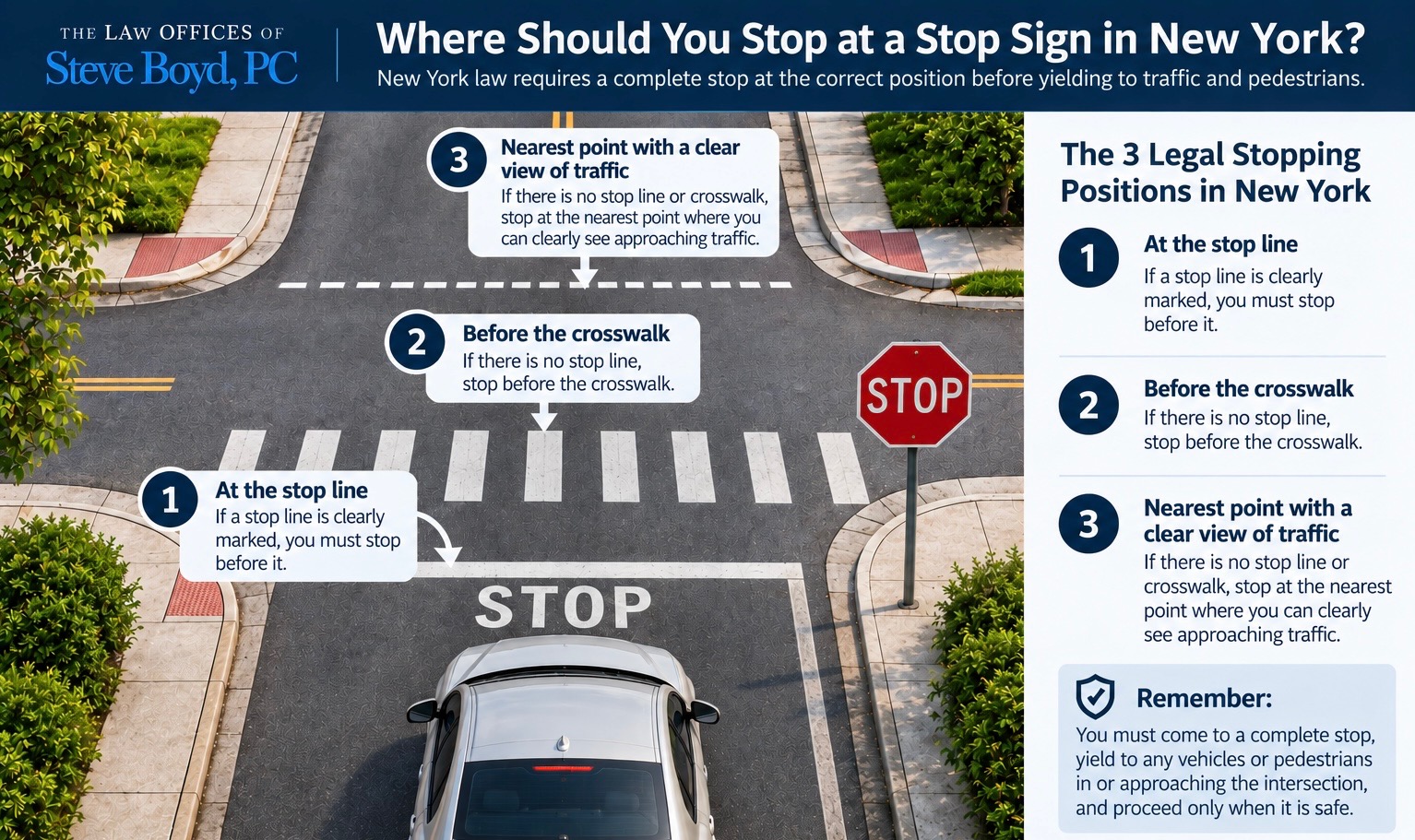
Under New York Vehicle and Traffic Law § 1172, every driver approaching a stop sign must come to a complete stop, no exceptions. The stop must happen at the correct position:
- At a clearly marked stop line, if one is present
- Before the crosswalk, if there is no stop line
- At the nearest point with a clear view of traffic, if there is no crosswalk
After stopping, the driver must yield to any vehicle or pedestrian already in or approaching the intersection. If another driver ignored these rules and you were hurt, our team can help.
Do You Have to Stop for a Specific Amount of Time?
Legally, there is no set time limit, but your vehicle must come to a complete cessation of movement, usually taking at least 2 to 3 seconds for the car to “settle.” Simply slowing down, often called a “rolling stop”, can result in a traffic ticket or a failed driving test.
The law focuses on the fact of stopping, not the duration. That said, a stop that lasts less than two seconds rarely gives a driver enough time to check for hazards properly. Courts and law enforcement look at whether the vehicle fully ceased movement, not whether the driver counted to three. If the car was still creeping forward when it entered the intersection, that is not a stop under New York law.
Get In Touch With Us
No Fees Unless We Win
716-600-0000What Is Considered a Complete Stop?
A complete stop means zero forward movement. The vehicle must be entirely still before the driver begins scanning the intersection. Slowing to two miles per hour and continuing through is not a complete stop, regardless of how brief that movement is.
Stopping Before the Crosswalk or Stop Line
According to the New York State DMV Driver’s Manual, drivers must stop before the stop line, or before the crosswalk if there is no line. These markings keep vehicles clear of pedestrians and give drivers a sightline into the intersection.
Yielding to Pedestrians and Other Vehicles
Stopping at the line is only the first obligation. Drivers must then yield to any vehicle or pedestrian in or approaching the intersection. At a four-way stop, the first to arrive goes first. When two vehicles arrive at the same time, the driver on the left yields to the driver on the right.
What Is a Rolling Stop and Is It Legal in New York?
A rolling stop, sometimes called a “California stop,” means the driver slows significantly but never brings the vehicle to a complete halt. Drivers who wonder how long should you stop at a stop sign and settle for a slow roll are breaking the law; it is one of the most common moving violations issued at intersections in New York.
Why Rolling Stops Are Illegal
A vehicle still in motion when it crosses the stop line has skipped the evaluation step a true stop is designed to create. Pedestrians, cyclists, and other drivers have the right to expect that a stopped vehicle is actually stopped. New York law does not allow anything less.
Common Misconceptions About Stopping Rules
No traffic nearby does not mean a complete stop is optional. Neither does stopping slightly past the line for a better view. New York law does not include exceptions for either situation.
Get In Touch With Us
No Fees Unless We Win
716-600-0000How Stop Sign Violations Lead to Car Accidents
Stop sign violations are a leading cause of intersection crashes in Buffalo and across New York. When a driver fails to stop completely, they eliminate the buffer time that allows everyone else at the intersection to react.
Failure to Yield and Intersection Crashes
The most common crash pattern involves a driver who rolls through a stop sign and strikes a vehicle crossing on the through street. Because the through-street driver had no stop sign, they had every right to assume the intersection was clear. The failure to stop removes that assumption and puts both vehicles on a collision course with almost no reaction time for either driver.
Liability in New York Personal Injury Cases
A driver who violated Vehicle and Traffic Law § 1172 by failing to stop completely can be found negligent in a New York personal injury case. New York’s comparative fault rule means that even partial negligence by a stop sign violator can result in significant liability. If you were injured in an intersection crash, The Law Offices of Steve Boyd, PC can help you understand what that means for your case.
Safety Tips for Approaching Stop Signs
Good habits at stop signs go beyond legal compliance. The New York State DMV Driver’s Manual answers, “How long should you stop at a stop sign?” as yielding right of way to all vehicles and pedestrians, and proceeding only when it is safe. Practically, that means:
- Stop before the line: halt completely behind the stop line or crosswalk
- Use the 3-second rule: counting to three ensures the vehicle is not still creeping
- Scan left, right, and left again: check for cars, cyclists, and pedestrians
- Yield appropriately: at a four-way stop, yield to whoever arrived first; if simultaneous, yield to the right
These steps take only a few seconds, but skipping any one of them can put everyone at the intersection at risk.
Contact a Buffalo Car Accident Lawyer
A stop sign violation can change everything. The Law Offices of Steve Boyd, PC serves clients in Buffalo, Niagara Falls, Tonawanda, and Batavia, and we know how an insufficient stop at a stop sign directly affects fault and compensation. Call (716) 600-0000 today for a free case review.


Unsure if you have a case? Let’s have a conversation; it will be completely confidential. We’ll believe you. We’ll walk you through the process so that you understand what this is, what we’ll do, and how your case will go as we stand with you every single step of the way.